

Twin Health Brings a Message of Possibility to Times Square for National Diabetes Month
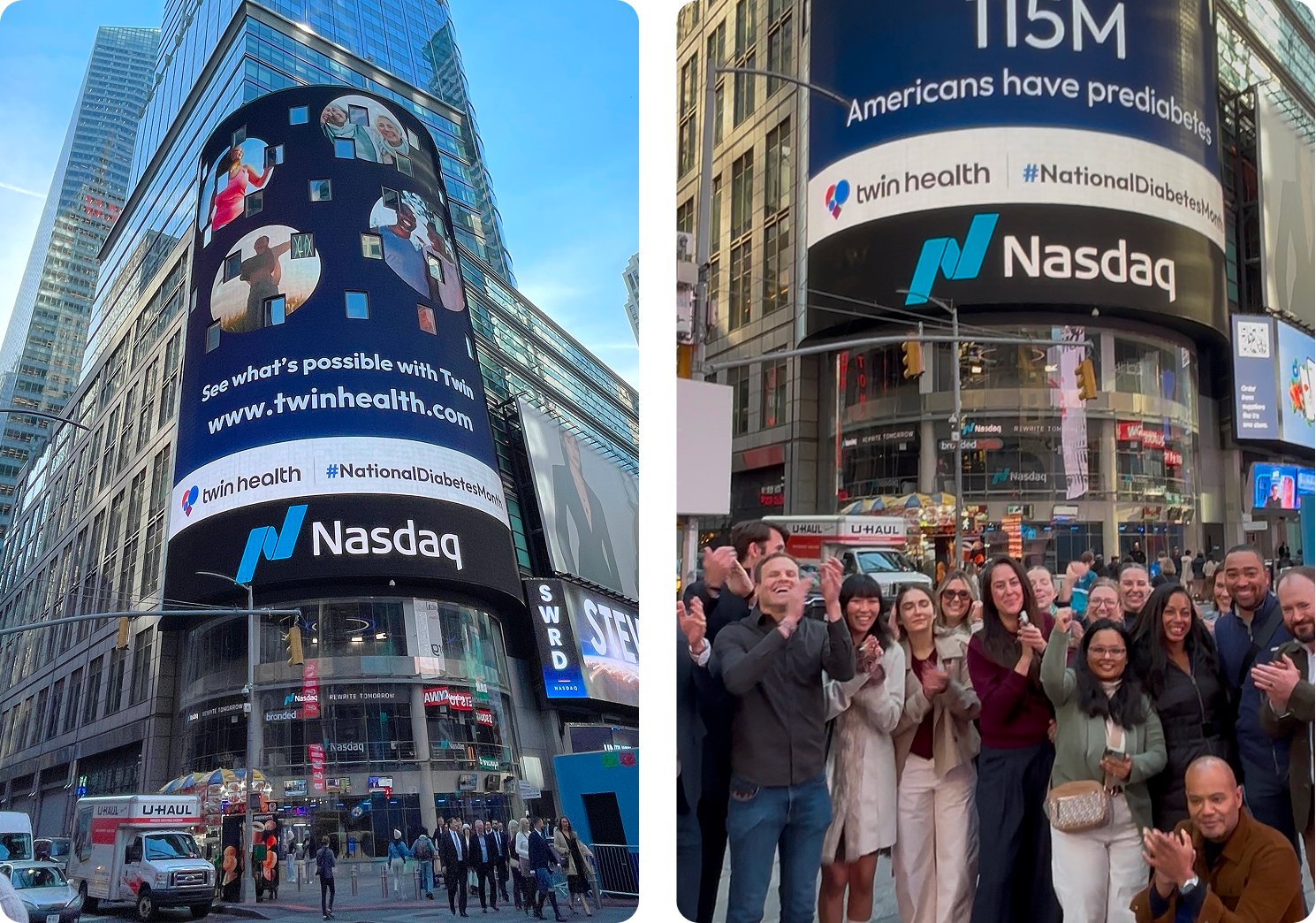
To mark National Diabetes Month, Twin Health brought a message to the Nasdaq Tower in Times Square, challenging assumptions about the future of type 2 diabetes care.
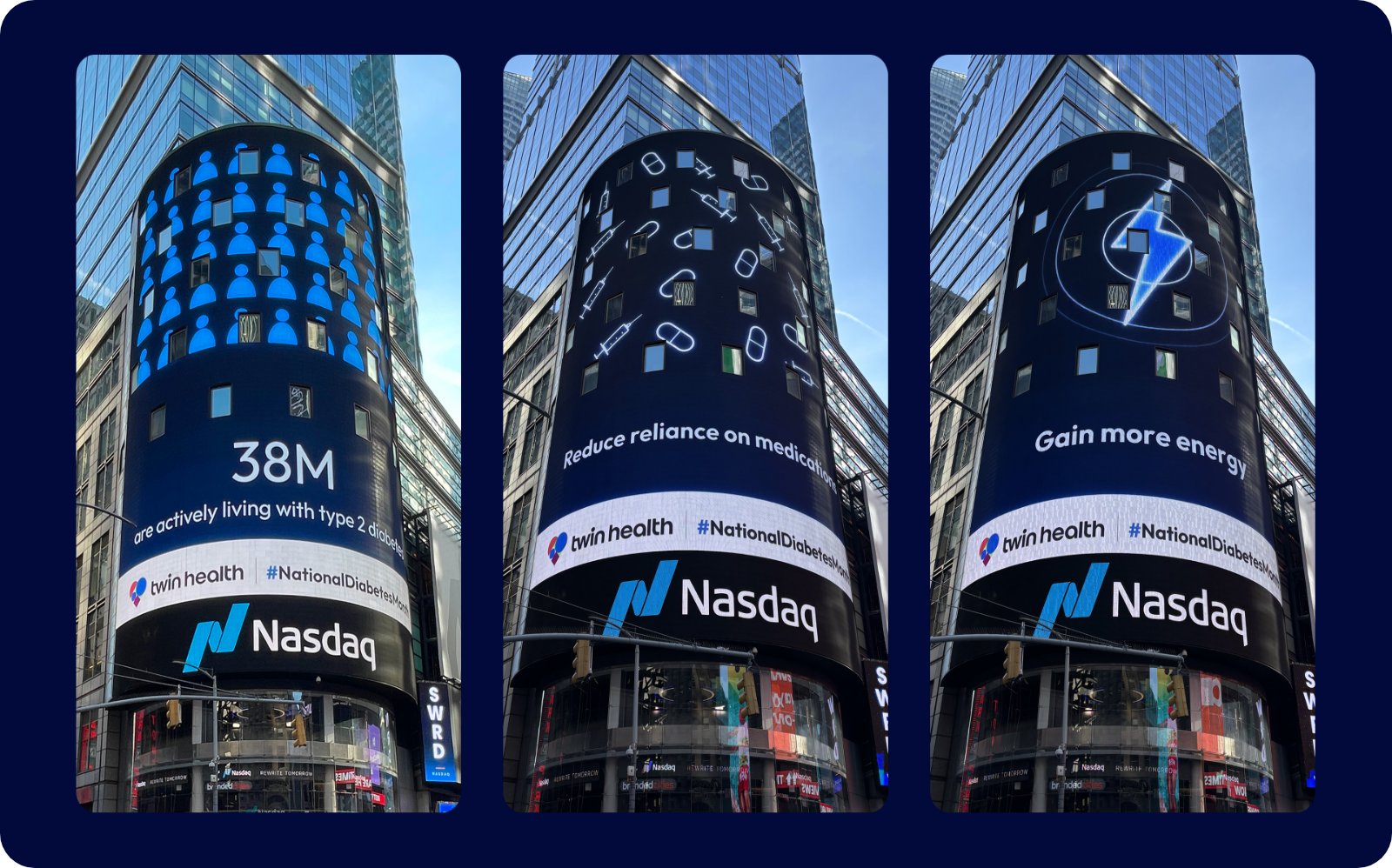
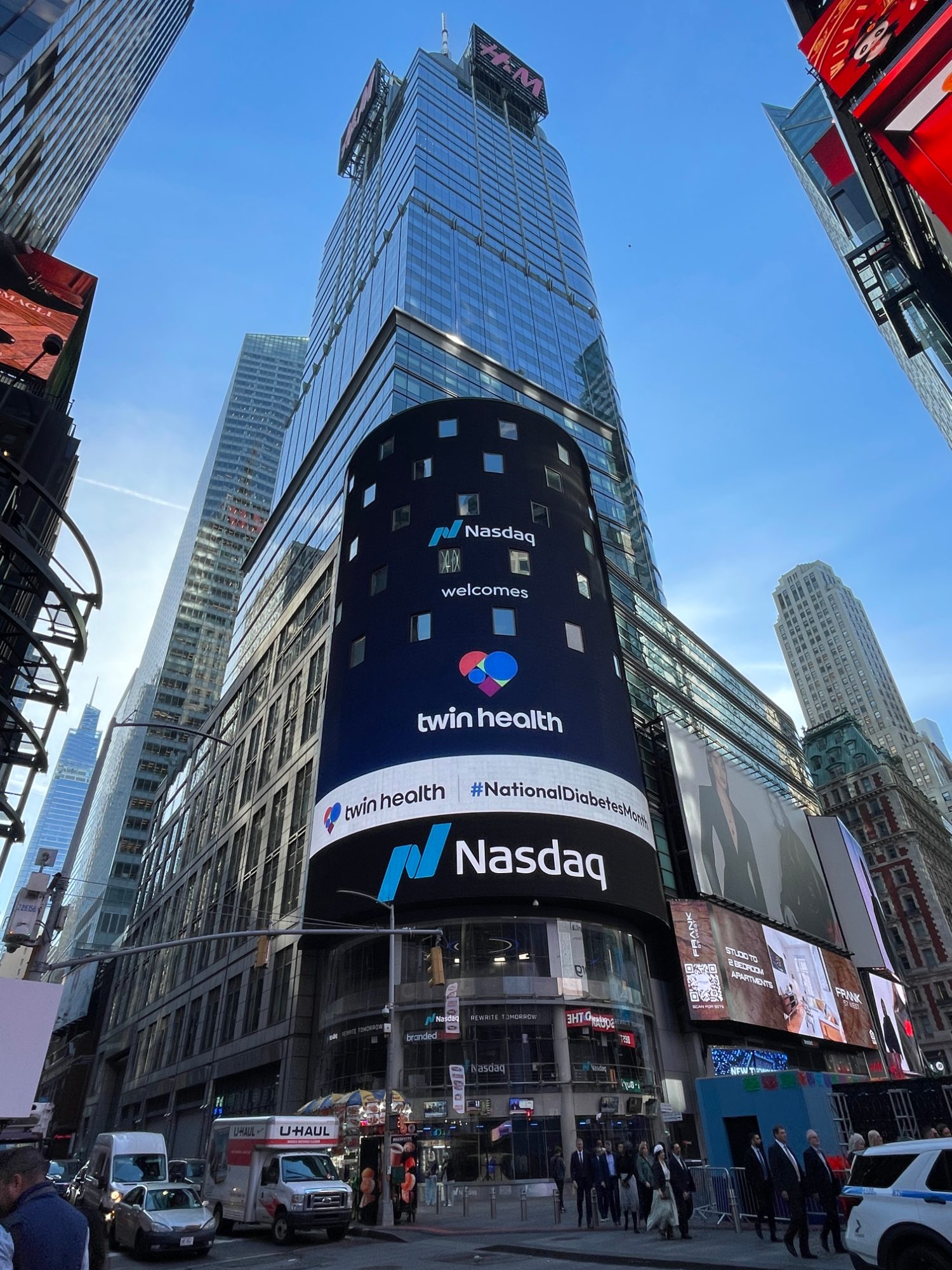
On November 2, we marked National Diabetes Month with a message on the Nasdaq Tower in Times Square: That type 2 diabetes can be prevented and reversed.
The 60-second video brought the scale of diabetes and prediabetes into public view, then turned toward what can change. Our goal was to open a broader campaign to raise awareness of cardiometabolic health, and to show why, and how the future of type 2 diabetes can look different.
Care that changes as people do
Our answer here at Twin starts with understanding each person’s metabolism.
The Digital Twin Care Platform consists of an AI Digital Twin and a clinical Care Team. The AI Digital Twin is a continuously updated model of an individual’s metabolic health, informed by data from connected devices. Together with the clinical Care Team, it helps translate those insights into daily guidance on food, movement, sleep, and stress.
As a person’s biology and daily life change, their guidance evolves. Our goal is to improve cardiometabolic health and, when clinically appropriate, reduce the need for medication under clinical supervision.
A national challenge with a personal impact
More than 115 million American adults have prediabetes. Eight in 10 of them don’t know it. Behind those numbers are people who already have some level of insulin resistance or inflammation, often without symptoms that would prompt them to seek care.¹
The effects reach families, workplaces, and communities across the country. Alongside the Times Square message, our localized campaigns brought that reality closer to home, connecting broad based national awareness with local statistics that affect the places people live.
Our Diabetes Awareness Month campaign asks people to reconsider an assumption that often follows a diagnosis: that worsening health and increasing medication needs are inevitable.
Evidence that expands what’s possible
In a Cleveland Clinic-led randomized controlled trial published in NEJM Catalyst, 71% of participants in the Twin group achieved an A1C below 6.5% at 12 months without glucose-lowering medications other than metformin, compared with 2.4% receiving usual care.²
Those results back up our campaign’s message: better health and lower healthcare costs are not mutually exclusive. With the right care, they should happen together.
National Diabetes Month creates an opportunity to bring that possibility into more conversations. We carry that message this November from Times Square into communities nationwide, with resources to help people understand the challenge and the evidence for a different path forward.
Source notes
- CDC, “Prediabetes: Could It Be You?”
- Cleveland Clinic-led randomized controlled trial published in NEJM Catalyst, 2025. Individual results may vary.
Media Coverage
Twin Health Brings a Message of Possibility to Times Square for National Diabetes Month
Oops! This content is hosted in another place.
Find it HereOn November 2, we marked National Diabetes Month with a message on the Nasdaq Tower in Times Square: That type 2 diabetes can be prevented and reversed.
The 60-second video brought the scale of diabetes and prediabetes into public view, then turned toward what can change. Our goal was to open a broader campaign to raise awareness of cardiometabolic health, and to show why, and how the future of type 2 diabetes can look different.
Care that changes as people do
Our answer here at Twin starts with understanding each person’s metabolism.
The Digital Twin Care Platform consists of an AI Digital Twin and a clinical Care Team. The AI Digital Twin is a continuously updated model of an individual’s metabolic health, informed by data from connected devices. Together with the clinical Care Team, it helps translate those insights into daily guidance on food, movement, sleep, and stress.
As a person’s biology and daily life change, their guidance evolves. Our goal is to improve cardiometabolic health and, when clinically appropriate, reduce the need for medication under clinical supervision.
A national challenge with a personal impact
More than 115 million American adults have prediabetes. Eight in 10 of them don’t know it. Behind those numbers are people who already have some level of insulin resistance or inflammation, often without symptoms that would prompt them to seek care.¹
The effects reach families, workplaces, and communities across the country. Alongside the Times Square message, our localized campaigns brought that reality closer to home, connecting broad based national awareness with local statistics that affect the places people live.
Our Diabetes Awareness Month campaign asks people to reconsider an assumption that often follows a diagnosis: that worsening health and increasing medication needs are inevitable.
Evidence that expands what’s possible
In a Cleveland Clinic-led randomized controlled trial published in NEJM Catalyst, 71% of participants in the Twin group achieved an A1C below 6.5% at 12 months without glucose-lowering medications other than metformin, compared with 2.4% receiving usual care.²
Those results back up our campaign’s message: better health and lower healthcare costs are not mutually exclusive. With the right care, they should happen together.
National Diabetes Month creates an opportunity to bring that possibility into more conversations. We carry that message this November from Times Square into communities nationwide, with resources to help people understand the challenge and the evidence for a different path forward.
Source notes
- CDC, “Prediabetes: Could It Be You?”
- Cleveland Clinic-led randomized controlled trial published in NEJM Catalyst, 2025. Individual results may vary.
No content exists for this entry