
The pharmacy savings from GLP-1 stewardship alone pay for themselves
Employers evaluating GLP-1 management programs are routinely asked to accept a leap of faith: pay for a program today and trust that downstream savings will eventually justify the cost. This analysis makes a narrower and harder claim — they don’t have to wait.
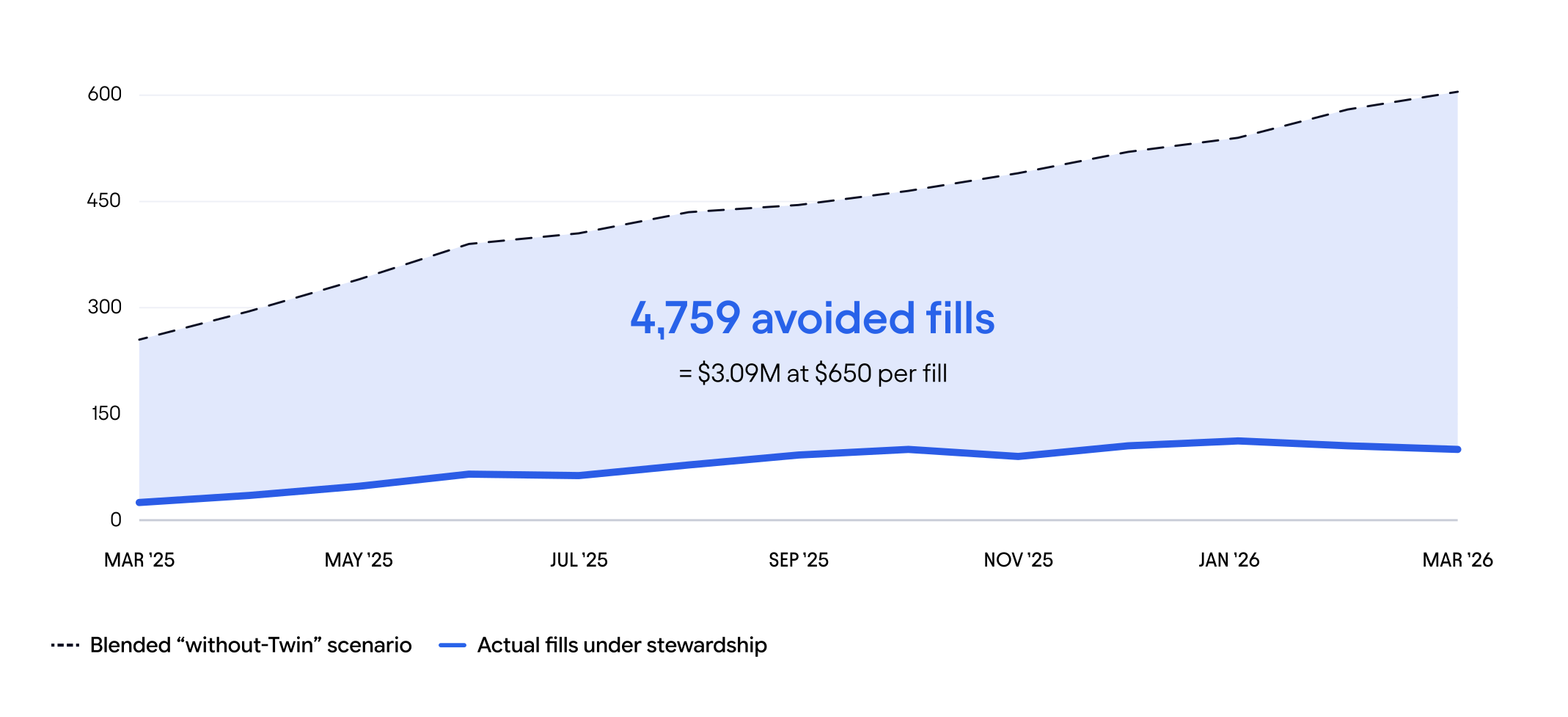
Over a 13-month window (March 2025 – March 2026) at a large self-insured employer in the entertainment industry (~12,200 covered lives), Twin’s GLP-1 stewardship program avoided an estimated 4,759 pharmacy fills versus the blended “without-Twin” scenario: what an unmanaged plan of the same size would have filled. Stewardship here means managed access to GLP-1s: members receive GLP-1 coverage, every prescription is written and clinically supervised by Twin, and staying on therapy requires active participation in the Twin program.
At a conservative $650 per fill — a post-rebate benchmark set below what plans typically pay net of rebates — that is $3.09M in gross pharmacy savings and $2.24M in net savings: a pharmacy-only ROI of 3.6x. We stress-tested the comparison four different ways; even the most conservative keeps ROI above 3x.
The GLP-1 cost problem
Weight-loss GLP-1 utilization is growing faster than nearly any other pharmacy line item. The Evernorth Research Institute reports national utilization growth of +73.1% in 2025 and a projected +52.9% in 2026.1 For a mid-sized plan, unmanaged adoption compounds into a seven-figure annual exposure within two years.
Stopping on its own is not saving: roughly two-thirds of members without diabetes stop therapy within a year, typically due to side effects or cost.2
Many later restart, returning those fills to the plan, and roughly 60% of lost weight is regained within a year of stopping.3,4 Discontinuation with weight rebound isn’t just disappointing for the patient — it is wasted spend for the plan. And there is no established clinical off ramp: published guidance remains inadequate.3
National GLP-1 Spend Annual Increases
Twin provides a tested medication de-escalation off ramp that maintains clinical results for the patient and ROI for the plan.
The Impact

Monthly GLP-1 fills:
Stewardship vs. the without-Twin scenario
The chart below is the argument in one picture: managed fills hold low and steady while the unmanaged path climbs month after month — the widening gap between the two lines is the savings.
Building the without-Twin comparison
Weight-loss GLP-1 utilization is growing faster than nearly any other pharmacy line item. The Evernorth Research Institute reports national utilization growth of +73.1% in 2025 and a projected +52.9% in 2026.1 For a mid-sized plan, unmanaged adoption compounds into a seven-figure annual exposure within two years.
Stopping on its own is not saving: roughly two-thirds of members without diabetes stop therapy within a year, typically due to side effects or cost.2
Many later restart, returning those fills to the plan, and roughly 60% of lost weight is regained within a year of stopping.3,4 Discontinuation with weight rebound isn’t just disappointing for the patient — it is wasted spend for the plan. And there is no established clinical off ramp: published guidance remains inadequate.3
Heading 3
Lorem ipsum dolor sit amet, consectetur adipiscing elit, sed do eiusmod tempor incididunt ut labore et dolore magna aliqua. Ut enim ad minim veniam, quis nostrud exercitation ullamco laboris nisi ut aliquip ex ea commodo consequat. Duis aute irure dolor in reprehenderit in voluptate velit esse cillum dolore eu fugiat nulla pariatur.
Path A — Comparator Employer Index. Real, observed fills at a comparator plan with no management program, adjusted for plan size — the most conservative comparison.5
Heading 3
Lorem ipsum dolor sit amet, consectetur adipiscing elit, sed do eiusmod tempor incididunt ut labore et dolore magna aliqua. Ut enim ad minim veniam, quis nostrud exercitation ullamco laboris nisi ut aliquip ex ea commodo consequat. Duis aute irure dolor in reprehenderit in voluptate velit esse cillum dolore eu fugiat nulla pariatur.
Path B — National Growth (Evernorth). The plan’s own starting utilization, grown at national GLP-1 rates published by the Evernorth Research Institute.1
Heading 3
Lorem ipsum dolor sit amet, consectetur adipiscing elit, sed do eiusmod tempor incididunt ut labore et dolore magna aliqua. Ut enim ad minim veniam, quis nostrud exercitation ullamco laboris nisi ut aliquip ex ea commodo consequat. Duis aute irure dolor in reprehenderit in voluptate velit esse cillum dolore eu fugiat nulla pariatur.
Path C — High-Growth Ceiling. The fastest-growth case: GLP-1 use growing as fast as observed at another large employer, where fills more than doubled (+115%) in a year.6
Heading 3
Lorem ipsum dolor sit amet, consectetur adipiscing elit, sed do eiusmod tempor incididunt ut labore et dolore magna aliqua. Ut enim ad minim veniam, quis nostrud exercitation ullamco laboris nisi ut aliquip ex ea commodo consequat. Duis aute irure dolor in reprehenderit in voluptate velit esse cillum dolore eu fugiat nulla pariatur.
Path D — Blended Consensus. The equal-weight average of Paths A, B, and C — the blended “without-Twin” scenario, and the primary reported result.
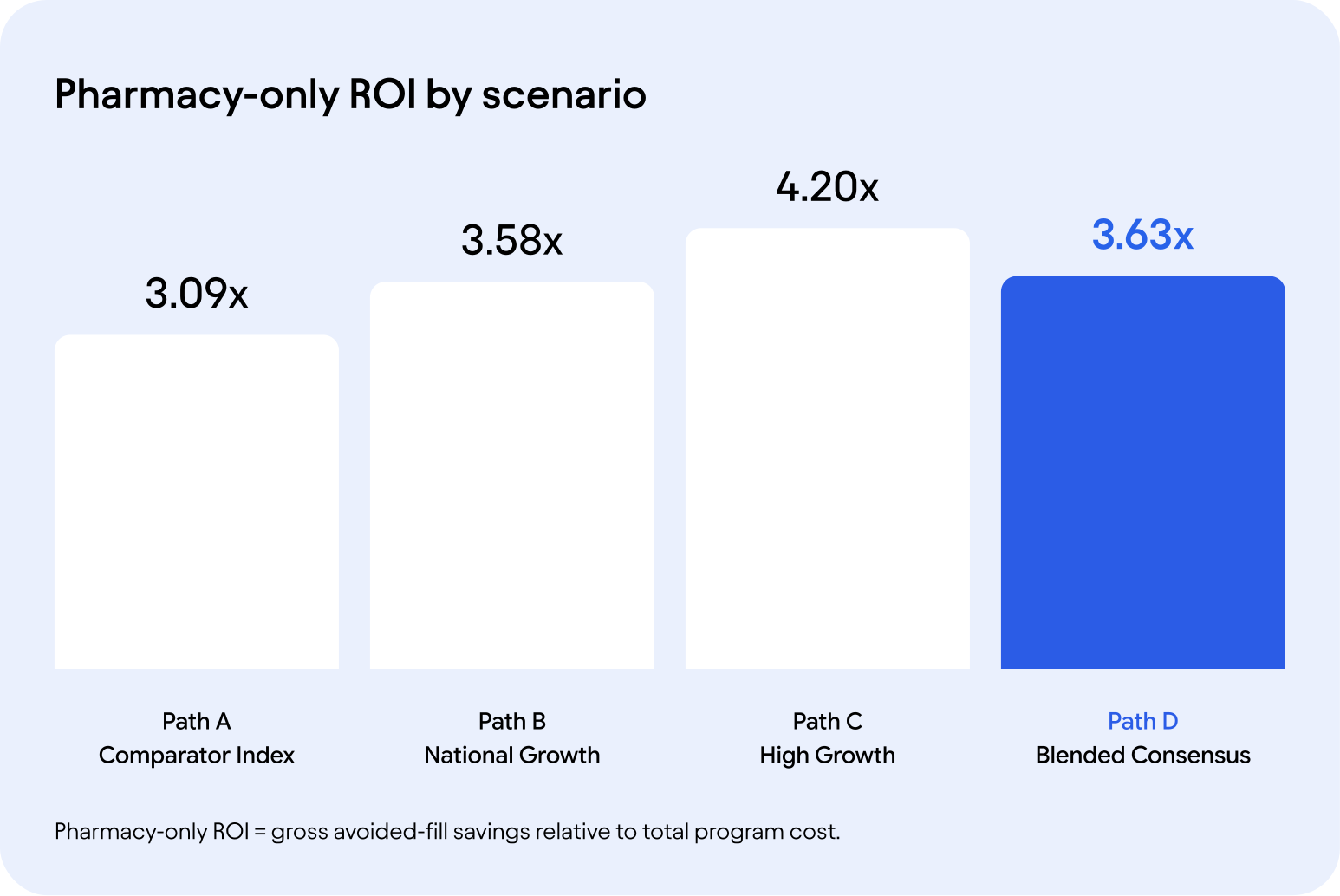
Over the 13-month window, fills under the program remained below the blended “without-Twin” scenario in every single month. We stress-tested the comparison four different ways; even the most conservative keeps ROI above 3x.
In addition to pharmacy savings, medical savings are an important consideration for the Twin program. We have previously demonstrated the medical savings impact of the Twin program in prediabetes and healthy weight management and in type 2 diabetes.7,8 Thus this ROI is conservative as it doesn't include medical savings which often make up a significant portion of the total savings in a program such as this.9
For this employer, pharmacy savings alone more than covered the cost of the program.
Twin Health combines sensor-based monitoring, an AI-powered Digital Twin metabolic model, and clinical coaching to improve metabolic health while safely managing and de-escalating high-cost medications. This analysis describes the real-world financial impact of the GLP-1 Stewardship program at a large self-insured employer through a claims-based evaluation.
Over a 13-month window, fills under stewardship remained below a conservatively modeled without-Twin scenario in every month, corresponding to 4,759 avoided fills, $3.09M in gross pharmacy savings, and a pharmacy-only ROI of 3.6x.
The central finding stands on the narrower measure: for this employer, pharmacy savings alone more than covered the cost of the program.
Appendix
Population & window
~12,200 covered lives at a large self-insured employer; 13-month operational window (Mar 2025 – Mar 2026); ~1,000 managed fills observed with zero plan leakage (no weight-loss GLP-1 fill outside the managed pathway). Comparator plan: ~30,800 covered lives, no stewardship program.
Methodology
Four-path counterfactual model designed to quasi-experimental good practice.¹⁰ All comparisons are adjusted for plan size (fills per 1,000 covered lives), so headcount growth cannot inflate the result. ROI figures reflect total program fees of $852,750 over the window, drawn from the audited financial system of record; fee structures vary by client.
Statistical strength
The gap between managed and unmanaged trajectories is positive in all 13 months and widens by +19.7 fills per month (heteroskedasticity - and autocorrelation-robust trend, p < 0.0001). A descriptive difference-in-differences comparison against the comparator plan is directionally consistent (β = −132.5 fills/month, p = 0.0095).10 Sensitivity analysis holds pharmacy-only ROI between 3.1x and 4.2x across a $550–$750 per-fill cost band, and 10,000-iteration Monte Carlo simulation per ISPOR-SMDM good-practice guidance11 shows a 0% probability of negative return, with all 9 automated verification checks passing.
Conservative approach
The projected paths phase in gradually over the first three months (60/80/90%), so the model does not claim savings before demand would realistically have ramped up; the $650 per-fill benchmark is a post-rebate figure set below both this plan’s observed net cost and the net prices most buyers see after rebates; and diabetes-maintenance prescriptions are excluded from all paths.
Limitations
Non-randomized observational comparison; $650/fill is a national post-rebate benchmark (sensitivity band $550–$750); T2D maintenance claims excluded from all paths.
De-identification
Comparator organizations are de-identified throughout; claims analyzed in compliance with HIPAA.
2 Rodriguez PJ, Zhang V, Gratzl S, et al. Discontinuation and Reinitiation of Dual-Labeled GLP-1 Receptor Agonists Among US Adults With Overweight or Obesity. JAMA Netw Open. 2025;8(1):e2457349.
3 Trajectory of weight regain after cessation of GLP-1 receptor agonists: a systematic review and nonlinear meta-regression. eClinicalMedicine. 2026.
4 Wilding JPH, Batterham RL, Davies M, et al. Weight regain and cardiometabolic effects after withdrawal of semaglutide: the STEP 1 trial extension. Diabetes Obes Metab. 2022;24(8):1553–1564.
5 Twin Health. Data on File — Comparator Employer Index: unmanaged comparator plan claims and eligibility analysis (Path A). 2026
6 Twin Health. Data on File — High-Growth Ceiling: sector employer GLP-1 utilization benchmark (Path C). 2026.
7 Koep T, Brooks C, Vidisheva Schifman A. Cost savings of an AI-enabled digital twin program in prediabetes and healthy weight management. Value in Health. 2026;29(S6):EE322. ISPOR 2026, Philadelphia, PA.
9 Validation Institute. Twin Health savings validation report. 2025. validationinstitute.com/mp-files/twin_health_savings_2025_final.pdf
10 Wing C, Simon K, Bello-Gomez RA. Designing Difference in Difference Studies: Best Practices for Public Health Policy Research. Annu Rev Public Health. 2018;39:453–469.
11 Briggs AH, Weinstein MC, Fenwick EAL, et al. Model Parameter Estimation and Uncertainty: ISPOR-SMDM Modeling Good Research Practices Task Force–6. Med Decis Making. 2012;32(5):722–732.